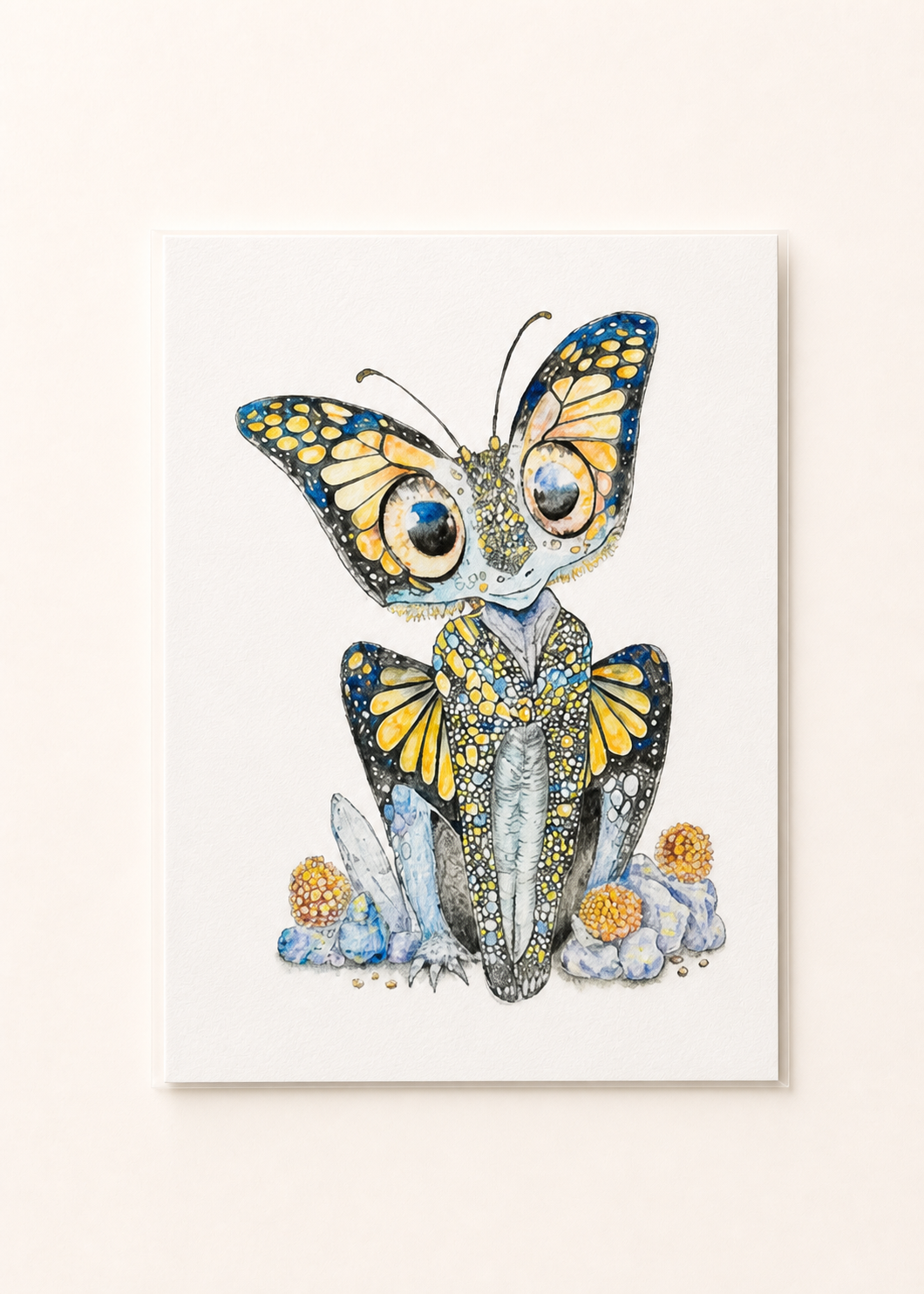
Auranthra is an original fantasy creature painted in watercolor and ink by Eva Luna. She gathers the wings of a monarch butterfly, the watchful stillness of a mantis, the curious eyes and adaptability of a chameleon, and crystalline markings that look as though she has been quietly collecting pieces of the earth.
She belongs to Thousand Gardens, a place in the Mythos & Alchemi Realm where transformation does not erase what came before. It gathers each former shape, carries it forward, and lets something beautifully strange emerge.

Who Is Auranthra?
Auranthra is gentle, timid at first, and endlessly curious.
She moves through crystal gardens, blooming wildflowers, and hidden places where wonder is still growing. She watches dragonflies skim across quiet water, follows shafts of sunlight through the leaves, and pauses wherever something is just beginning to become itself.
Her story begins with a single line:
Some wings are painted by sunlight. Others carry the memory of it.
That memory lives throughout the artwork. Gold rests inside the dark webbing of her wings, blue gathers around her enormous eyes, and small crystalline details travel over her body like an unfamiliar constellation. She looks as though she has stepped out of an antique natural-history folio from a world very close to ours... just slightly more peculiar.
What Animals Inspired Auranthra?
Auranthra combines three creatures, each offering a different piece of her character.
The monarch gave her transformation
The North American monarch butterfly, Danaus plexippus, is known for its orange-and-black wings, long migration, and extraordinary metamorphosis. Its wings are covered in thousands of tiny scales, flattened structures that hold pigment or interact with light. The scientific name for the butterfly and moth order, Lepidoptera, comes from Greek words meaning “scale” and “wing.” The American Museum of Natural History explains how those scales work almost like individual pixels, gathering to create the colors and patterns we recognize.
In Auranthra, monarch markings appear in warm yellow, black, cream, and blue. They are familiar enough to awaken recognition, while the creature carrying them belongs entirely to another Realm.
The monarch also brings the idea of becoming. A caterpillar disappears inside a chrysalis and emerges with a body it has never used before, carrying instincts for flight and migration. Auranthra holds that same mystery, the possibility that change may reveal something that was waiting inside us all along.

The mantis gave her stillness
In the Auranthra poem, the mantis teaches her “the art of listening to light.”
That feels exactly right for the figure in the painting. Her body is poised and narrow, her limbs folded close, as though she has gone completely still to hear something the rest of us missed. She is attentive rather than frozen. Quietly alert. Probably watching three different mysteries at once.
The mantis contributes patience to Auranthra’s transformation. Some changes happen with noise and falling walls. Others happen while we sit very still and realize that the light has shifted.
The chameleon gave her curiosity
Chameleons contributed Auranthra’s enormous searching eyes and her relationship with color and concealment.
Real chameleons can move their eyes independently, allowing them to observe different parts of their surroundings simultaneously. Their color changes are frequently used for communication and responses to light, temperature, mood, or stress. Contrary to the familiar story, they do not simply copy any background placed behind them. The Smithsonian’s National Zoo describes color change as an important form of chameleon communication.
Auranthra turns those natural abilities into mythology. In her poem, the chameleon shows her:
how to disappear beautifully
how to morph and still remain herself
There is something lovely in that. Adaptation does not have to mean losing your identity. Auranthra changes, fades, listens, and wanders, while remaining unmistakably Auranthra.
How Was Auranthra Created?
Auranthra was created with watercolor and ink.
Ink gives the creature her delicate structure, defining the branching veins in her wings, the tiny markings across her body, her fine limbs, and the curious architecture of her face. Watercolor carries the softer changes, pale blue moving into gold, warm cream fading into shadow, and translucent layers allowing the paper’s light to remain present.
The materials suit her. Watercolor can drift, bloom, stain, and settle into unexpected edges, while ink remembers every small decision. One wanders and one holds the map.
The completed artwork brings those qualities together in a creature filled with intricate details. Her monarch patterns repeat across her wings and body, her eyes appear almost planetary, and crystal forms gather around her feet as though the garden itself has paused to meet her.

What Does Auranthra’s Poem Reveal?
The poem identifies Auranthra as Artifact 064, originating in Thousand Gardens.
It tells us she was:
“birthed where dreams exhale into light”
and carries “a monarch’s pulse” inside her wings. The poem also gives her an effect on the world around her. Where Auranthra moves, the air bends like glass and colors forget their names. When she disappears, the world exhales gold, remembering that she passed through it.
The poem makes her feel less like a character posing inside a painting and more like a creature briefly observed. She was here. She listened. She changed the light. Then she slipped back into the garden before anyone could ask too many practical questions.
Kinda the best way for a mythical creature to behave.

A Creature for the Threshold of Becoming
In the Realm, Auranthra appears wherever transformation is quietly unfolding, near newly opened flowers, emerging butterflies, and those standing at the edge of a new chapter.
Her story does not insist that growth must be loud or fearless. Auranthra is timid. She pauses. She watches. She disappears when she needs to.
And still, she transforms.
You can meet her in the Auranthra fine-art print, send a little piece of her world through the 5×7 deckled-edge Auranthra greeting card, or carry her curiosity on the weatherproof Auranthra vinyl sticker.
Wherever she goes, the light may behave a little strangely afterward.